Confluence is an opportunity to practice presenting your work, receive feedback on your proposed research or results, learn about research in your community, and (in some cases) even fulfill requirements of your degree/department. To present a poster or give an oral presentation at this year's symposium, please submit an abstract by Friday, March 13th, 2026. Before submitting your abstract, please see our guidelines for abstracts, posters, and oral presentations below.
As you may present either proposed research or research results, we have included guidelines for each. Please note that, generally, proposed research is presented in poster form, whereas research results are presented orally. However, we are happy to accommodate students who would like to deviate from this and encourage you to contact us with any questions.
- Abstracts should be no longer than 300 words.
- In addition to the title of your presentation/poster, you should include your name, major advisor(s), and co-authors. For each person listed, be sure to include their academic institution and department/program.
- Type your abstract as a single text block (indents and line breaks may be removed).
- Use title case for the title of the poster or presentation.
- Include author information in the uploaded abstract document.
- Citations are not allowed within the abstract text and will be removed.
- Work must be proofread carefully before submission. Abstracts that show lack of care or quality control as evidenced by grammar, punctuation, spelling, and typographical errors may be returned requesting revision. Confluence organizers will not edit abstracts.
Presenting Proposed Research
If you are submitting an abstract for Research Results,
we suggest including the following in your abstract:
Background: a brief statement of study’s objectives
Methods: a concise statement of methods
Results: a clear presentation of results which should be “data rich”
Conclusions: a closing statement of conclusions (Do not state “Results will be discussed.”)
Presenting Research Results
If you are submitting an abstract for Proposed Research,
we suggest including the following in your abstract:
Background: a brief statement of the study’s objectives
Question(s) and hypotheses
Methods: a concise statement of methods
Interpretation: a description of the scope of inference
Importance: a brief statement of how your research will contribute to your field
- Presentations should be created in a format compatible with PowerPoint (.pptx). All presentation rooms will display in Windows operating systems, so a presentations created using a Mac should test the file on a PC computer prior to the meeting.
- Student presenters must provide their presentations to the Confluence Committee by 10:00 PM Thursday, April 9th. You will receive an email from a committee chair with instructions on how to upload your talk.
- You are allotted 12 minutes for an oral presentation, with 3 for questions from the audience.
- Each session will have a session coordinator who will hold up cards at the 5-minute mark and last-minute mark to help you stay on time.
- Presentations should be targeted towards a broad audience from diverse backgrounds. The audience will be composed of individuals from specialties outside of your own.
- Presenters will be contacted before the day of the event with further instructions on the assigned time and room for their presentation.
- We highly recommend watching this presentation by Dr. Jim Rivers (FES) on crafting an effective scientific talk.
Please contact us with any presentation questions.
What are the poster requirements?
Posters should be in landscape layout. We recommend 36"x48" dimensions. Please NO glossy or laminated posters.
Where can I print a poster for the symposium?
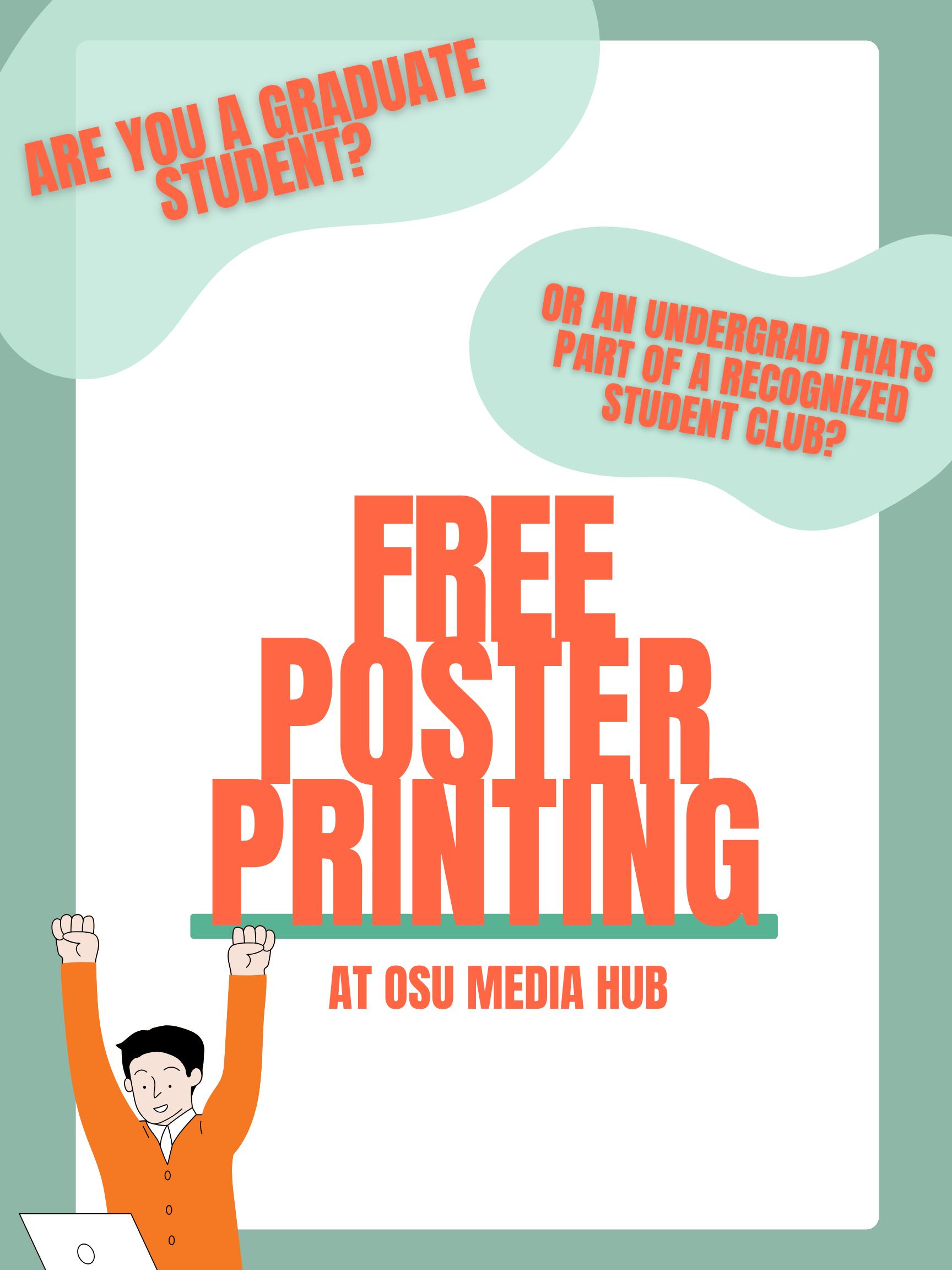
Multimedia Services is located on the main floor of the Valley Library and accepts posters via email or in person on a thumb drive. They need 48 hours to create the poster and are closed on the weekend. If you want your poster ready by Friday, please make sure you submit your poster to them by the Wednesday before Confluence.
Where do I set up my poster on the day of the event?
Poster presentation sessions will be held in the Peavy atrium during two lunch blocks, and display boards and clamps will be provided. Your assignment presentation block will be assigned to you beforehand via email and all student presenters must be present next to their posters during their session.
What should my poster include?
Please see the recommended poster content below (provided by Lisa Ganio):
- Title and Presenter: Include your name, email contact and major professor. If there are other significant collaborators please include them as well.
- General Research Question or Objective: State the general question your research will address, and any specific objectives of your project.
- Background: Briefly put your research into context with regards to current knowledge on the topic and the importance of your question.
- Specific Questions and assumptions: State one or more specific questions to be addressed by the methods described below. These can be stated as postulates, succinct questions or hypotheses. Note that these are NOT statistical hypotheses. State (non-null) scientific hypotheses. List the critical axioms or assumptions.
- Methods: Describe the approach you propose to use to address each specific question – give your proposed response variable(s) and any explanatory variables, describe how the data are (or were) to be collected, study design (e.g., observational, survey, experiment), sampling plan and suggested analysis method. This is a minor part of the poster because it may not be well-developed at this point and it typically changes as the proposal evolves.
- Interpretation: Provide the scope of inference – that is, identify the set or group to which the conclusions of your proposed research will apply. Provide the expected outcomes for your scientific hypotheses. Explain what types of data responses will lead to what types of answers to your questions.
- Importance: Explain how your thesis work will provide a significant contribution to the body of knowledge in your field. This section can act as a summary to the poster. Sometimes the importance of the proposed work is included in the background section identified above.
We encourage you to check out this recorded talk by Dr. Jim Rivers (FERM) on crafting an effective scientific presentation for additional tips.
I've never presented before, what does this process look like?
No worries! We welcome all skill levels at Confluence and we encourage undergraduates and first time presenters to gain experience talking about their research with their peers. Below are some basic tips to help get you started:
- Discuss the proposed research with your major professor and make sure you are in agreement with regards to the specific questions, assumptions, methods and interpretation.
- Develop a rough draft of your poster (reduced scale) and have it reviewed by your major professor and others who might provide useful feedback.
- Print a draft color copy of the final poster on 11x17 paper (CoF help desk or FWCS office can help with this) before producing a full scale version.
- Go to Student Multimedia Services (Valley Library, 2nd floor) to produce the final version: Media Hub
- DO NOT PROCRASTINATE! Leave plenty of time to work out the wrinkles. Note the time to produce the poster that the Student Media Services requires as well.