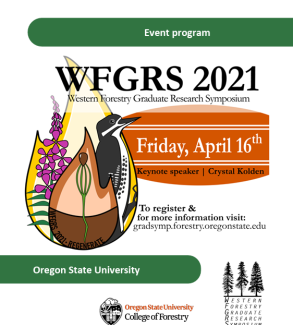
The 2021 Western Forestry Graduate Research Symposium was held virtually in 2021. Videos from the symposium are below, where you’ll find student presentations and a keynote presentation from Dr. Crystal Kolden.
WFGRS 2021 Keynote Speaker || crystal kolden
Crystal Kolden, University of California Merced | Rethinking how we measure wildfires: Putting the 2020 Fire Season in context
The 2020 fire season was characterized by both broken records and extreme events, consistent with recent trends in fire activity globally resulting from anthropogenic climate change. Globally, fires burned with greater intensity and longer duration across several fire-dominated regions, including in parts of the US. Notable fires also occurred in places where it is infrequent, surprising many. But was 2020 truly a wildfire disaster? Answering this question requires getting beyond the media hype and our illogical obsession with fire size. Here, Crystal characterizes the 2020 US fire season across a range of qualitative and quantitative attributes in order to characterize both the short-term and potential long-term impacts. She also suggests a theoretical framework for wildfire researchers seeking to change the culture of communication, disengage with disaster narratives, and improve scientific understanding of fire drivers and impacts.
Dr. Crystal Kolden is a pyrogeographer in the Management of Complex Systems department at the University of California, Merced, and a former wildland firefighter. She holds a doctorate in Geography and served as a research scientist for both the US Forest Service in California and US Geological Survey in Alaska prior to her academic career. She conducts research on reducing vulnerability to wildfire disasters globally through improved understanding of coupled human-environment drivers.
Morning Session A
Claire Tortorelli | Interactions between plant community trait composition and environmental stress influence community resistance to a recent annual grass invader, Ventenata dubia
Rebecca Weber | Can the rate of vegetation recovery predict reburn severity?
Katie Wampler | Predicting source water quality following wildfires using hydrologic modeling
Sam Freedman | Modeling the financial viability & carbon sequestration potential of agroforestry and silvopasture in southern Vermont, U.S.
Ben Rushakoff | An analysis of Oregon’s preferential forest property tax programs: Results from a survey study
Morning Session B
Mark Kerstens | Moving between green and black: Natal dispersal and survival of juvenile Black-backed Woodpeckers (Picoides arcticus)
Jason Piasecki | Red tree voles: Exploring forest occupancy
Rachel Zitomer | Forest age and floral resource availability drive native bee abundance and diversity in intensively managed forests of the Oregon Coast Range
Dustin Gannon | Pairing automated mark-recapture and social network models to explore the effects of forest encroachment on hummingbird movement
Jordan Ellison | Investigating the conservation value of slash piles for Pacific martens and fishers
Afternoon Session A (note the video starts in the middle of the first presentation)
Madelene Elfstrom | Drought resistance and resilience in mature Douglas-fir in western Oregon
Stephanie Winters | Resistance or resilience in soil carbon pools? Exploring soil carbon dynamics using common forest organic matter removal practices in Long Term Soil Productivity sites from California to New Zealand
Lucie Law | Riparian restoration: Planted tree and shrub survival and growth
Sudeera Wickramarathna | Assessment of the herbicide effectiveness on reed canary grass
Kathy Young | Undergraduate research experiences: Impacts and opportunities
Colby Parkinson | Environmental- and individual-level determinants of outdoor recreation participation during the COVID-19 pandemic
Afternoon Session B (note that the broadcast starts in the middle of the first presentation):
Nathan Ryan | Effects of overexpressing the GRF4-GIF1 transcription factor chimera on transformation efficiency in Populus and Eucalyptus
Xavier Vinton Tacker | CRISPR-modification of floral genes in Eucalyptus: Impacts on flower structure and pollen development
Carver Heine | Impact of classification algorithms on modeling forest ground from point clouds
Todd West | Heuristic optimization of thinning individual Douglas-fir: Behind the scenes
Mandira Pokharel | Timber faller safety on integrated mechanized operations in steep terrain
Jun Zhai | Incidence of domestic subsidies vs. export taxes: An equilibrium displacement model of log and lumber markets in Oregon